The Art and Science of Blinking
Around 2,450 years ago the ancient Greek philosopher Zeno of Elea was perhaps the first to methodically question a simple fact of life - how do we physically move, such as when blinking an eye, running, or simply falling down?
Culturally we are about to fall off a philosophical cliff. Fortunately, a safe landing in a far more compassionate, sane and exciting world awaits those who come to the edge with the understanding of how to fly.
His questions and arguments, which have become widely known as Zeno's Paradoxes, pointed to the seemingly logical impossibility of the everyday experience of physical movement.
His considerations have perplexed and troubled philosophers and scientists even since. Various assumptions that underpin our modern technologies and sciences were taken for granted. We take for granted that there is always a physical cause for every physical effect - as exemplified by scientists researching to find physical cures for disease, cancer and viruses; and to find the physical genes or brain cells responsible for thoughts, beliefs, emotions, and the experience of love, creativity and joy.
Now, with the advances in the field of quantum physics, we know that a 2,450 year era is nearing its end .. an era in which it has been assumed that our physical brains, bodies and the entire physical universe is continuously existent. An era in which each part (atom, virus, cell, organ, person, planet) was assumed to be continuously existent and functional, with every part contributing to the running of, or dysfunction of, the machinery of life.
We stand at the edge of a grand new understanding of our universe, and ourselves. As Visa International founder Dee Hock foretells, a new era
is struggling to be born -- a shifting of culture, science, society, and institutions enormously greater than the world has ever experienced. Ahead, the possibility of the regeneration of individuality, liberty, community, and ethics such as the world has never known, and a harmony with nature, with one another, and with the divine intelligence such as the world has never dreamed."
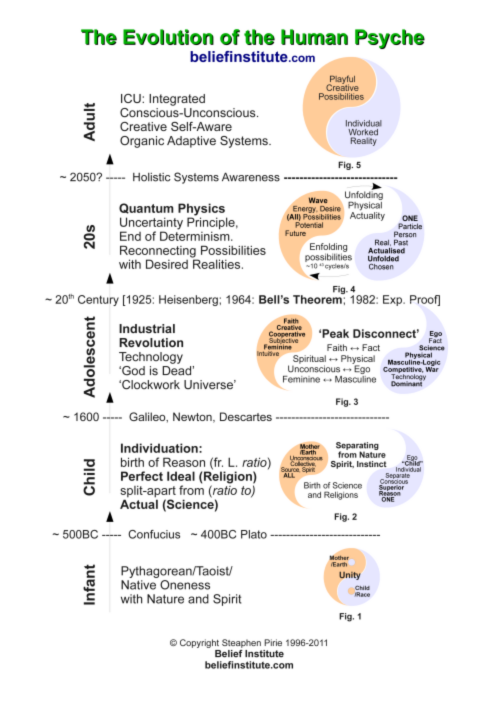 Given current world circumstances (e.g. the 2008 global economic situation; recent and current controversies in the USA over the teaching of "Intelligent Design" and recent demonstrations against cartoons and books that are deemed blasphemous) perhaps it's timely that we gain a fuller perspective. It is quite evident there are conflicting views on what is "Truth."
 "The Dynamics of Gender and Life" ebook is now available at